10 July 2011

Meat-on-A-Stick Extravaganza

[Note: Links will appear as I post each entry, but they may not all be available for several weeks.]
For 4th of July this year, I decided to sample a variety of different meat-on-a-stick recipes from Asia. The offerings included:
  • Chinese BBQ'd Tofu
  • Indonesian Beef Satay
  • Japanese Chicken Yakitori
  • Indian Chicken Tikka
  • Filipino Barbecue Pork

The end result was, obviously, too much food. I had a lot of fun, though, planning and cooking. Plus, I learned a lot and we all ate well. Which is what it's all about.

In the weeks since Independence Day, I've been pre-occupied with a sick dog that needed an expensive operation and close attention. I have not, until now, taken time to write up the blog entries for this meat-on-a-stick extravaganza. I am still planning, however, to write about each recipe separately, giving each one its own blog entry. (Just click on one of the links above--as they appear in bold--to read more about that recipe.)

It may take some time before all the recipes/blog entries are completed. Thanks for your patience.

08 July 2011

Guilty Pleasures: Indonesian Peanut Sauce, Thai Sticky Rice & Dutch Patatjes Oorlog

A ball of sticky rice, spicy peanut sauce, and raw veggies.
As part of my 4th of July celebration this year, I decided to grill a bunch of "meat on a stick" using recipes from different Asian cuisines. (See the upcoming blog on July 10th entitled "Meat on A Stick Extravaganza" for those recipes). To go with Indonesian Beef Satay, I decided to make spicy peanut dipping sauce, something I haven't made in a while.

Just the thought of peanut sauce sent my mind spinning around the many, many possibilities that peanut sauce offers. It's not just a dipping sauce for meat on a stick. It is also the centerpiece for one of my favorite comfort meals of all time: peanut sauce with sticky rice and raw veggies. Peanut sauce appears in a classic Indonesian salad called Gado-Gado AND it is the unlikely companion to mayonnaise  in the Dutch heart attack known as patatjes oorlog (oorlog = "war").

Oh, yum! But first, I had to make the sauce, a lot of it. 

America is the home of peanut butter, so you might think finding good peanut butter would be easy.  But it's not. If I had been thinking ahead, I would have remembered to get some peanut butter from Whole Foods in Cleveland, where you can grind the peanuts yourself. Unfortunately, however, I had failed to plan ahead and was at the mercy of the local grocery store chains.

Before I got to the store, I had already decided that I wanted the most "natural" peanut butter available in a jar. I wanted nothing artificial, no additives and no sugar (or sweeteners of any kind), if at all possible. As I stepped up to the shelf, I naturally reached for the jar that said "Naturally," the one that assured me that it contained "what peanut butter should be":
Having been fooled before by labels, I turned the jar around to read the fine print:
Wow. I knew that processors sometimes added sugar or honey, but this was the first time I had ever seen 'flax seed,' 'wheat germ,' or 'egg white' on the ingredients list for peanut butter. And these were ingredients in addition to both sugar and honey. While no single item appears to be bad for you, the point is that this jar does not contain plain peanut butter.

My heart sank because the only other brand names on the shelf were the usual commercial suspects. Oh, but wait . . . they each had a "natural" version of themselves, in addition to their original formulas. Let's take a look . . .

I had to admit, Jif Natural was looking pretty good, compared to the first jar. Despite the sugar, I decided it was probably okay. After all, it was real sugar, not high fructose corn syrup or "corn sugar." Nonetheless, I decided to check out the third "natural" offering:


Yes!! That's more like it! Peanuts + salt = perfect!

Indonesian Peanut Sauce
  • 1 medium onion, finely diced
  • 1 inch ginger root, finely minced or grated
  • 5 cloves garlic, crushed
  • 2 T. vegetable oil
  • 4 anchovy fillets, smashed
  • 1 teaspoon ground cumin
  • 2 teaspoon ground coriander
  • 1 cup good broth (vegetable or chicken) or water
  • 1 can unsweetened coconut milk
  • 4 kaffir lime leaves or 1 lemongrass stalk, cut into 3-inch pieces (optional)
  • 2 1/2 cups of peanut butter
  • 1 to 2 tablespoon crushed red chilies or sambal oelek (optional)
Saute the onion, ginger root and garlic in the oil until the onion is translucent. Add the smashed anchovies, cumin, and coriander and continue to saute for 2 to 3 minutes.

Do NOT omit the anchovies, however tempted you may be to toss them out or forget about them. When the sauce is done, you will not taste anchovies, I promise. However, if you leave the anchovies out, the sauce will not have the complexity and depth of flavor you want in a Southeast Asian dipping sauce. Without the anchovies, you might as well skip cooking altogether and just stick your meat on stick into the peanut butter jar.

Once the spices and anchovies start to "bloom" with aroma, add the broth or water and the coconut milk, along with the kaffir lime leaves or lemongrass, if you are using them. When the liquid comes to a boil, lower the heat to a simmer and put the lid on the pot. Allow the broth to simmer for 30 minutes or so, to allow the flavors to "marry."

Turn off the heat and discard the lime leaves and/or lemongrass. Carefully stir in the peanut butter. Be careful about splashing the hot broth on yourself. As you stir, it will seem--at first--like the peanut butter is not melting and is lumping up, but persevere. Keep stirring and stirring. Eventually, the peanut butter will melt and you will end up with a thick, smooth sauce. Add the chilies or sambal, if you are spicing up the sauce.

My main reason for making the sauce was to serve it with these: Indonesian Beef Satay...
But I purposely made too much sauce for the amount of satay sticks I had. This recipe makes a quart, so feel free to cut the recipe in half, if you like. Or, better yet, keep the excess in your fridge or freezer for other delicious peanut-sauce meals . . . like peanut sauce with sticky rice!

EASY Thai Sticky Rice  

Sticky rice is usually steamed on the stovetop with special equipment and cheesecloth and a lot of patience.
A few months ago, however, I came across a recipe that used a rice cooker. It's a very simple, very easy recipe:

  • 2 cups Thai glutinous rice (this rice is gluten free, by the way; 'glutinous' refers only to its stickiness, not to any gluten content)
  • 2 1/2 cups water
  • 1/2 tsp. salt
Put the rice and the water in your rice cooker. Do not turn the cooker on yet, however. Close the lid and allow the rice to soak for 1 to 4 hours depending on the rice.

On this particular day, I opened the bag of rice for the first time. It was a brand name I'd never seen before, so I had absolutely no experience with this particular product. Based on past experience with other sticky rices, however, I decided to soak the rice for 3 hours. As it turned out, however, the rice was a little too soft for my tastes. When I make this again using this brand of rice, I will soak the rice for only 2 hours. The rice was delicious, by the way, even though it was a little softer than I like it. (I like it chewy.)

Add the salt and stir it into the rice and water, then close the lid and cook the rice. (If you don't have a rice cooker, you can cook this on the stovetop. Keeping the lid on, bring the water and rice up to a boil, then turn the heat down as low as you can get it. Cook for 20 to 30 minutes, until all the water is absorbed by the rice.) As soon as the rice is done, make sure the machine and/or is turned off.

Allow the rice to cool to room temperature because Thai sticky rice dipped in peanut sauce is a sensual experience that is always done with naked fingers!

Mel's Patatjes Oorlog -- Oven Fries with Mayonnaise and Peanut Sauce

Another guilty pleasure of mine, when it comes to spicy peanut sauce, is something I was introduced to when I lived in The Netherlands during the 1990's. Patatjes Oorlog translates to something like "fries, war-style" or "war fries." They were a very popular street food at that time--a paper cone or paper dish piled high with fried potatoes and doused (1/2 and 1/2) with mayonnaise and peanut sauce.

When I asked one street vendor why they were called "war" fries, he said, "Well, it's like the war, you know, when Indonesians and the Dutch fought after World War II." Ah! It suddenly made perfect sense: A war for independence that is, in reality, a love affair.

As you can see, my homemade version of patatjes oorlog involves oven fries instead of deep fried potatoes. I try to tell myself that they're healthier than the Dutch version, but I know I'm stretching the truth. The truth is that I have no business eating this plate of guilty pleasure, especially given my sedentary American life style, a life in which I sit to do almost everything from working to socializing to being entertained to moving myself from home to work and home again.

In Holland, I ate those supposedly evil, deep fried patatjes oorlog, but I walked and biked everywhere, paddled paddle boats in canals, carried my groceries home in my arms almost every day (because without preservatives, food must be purchased fresh), did not own a car, and I spent almost no time in front of the television. Actually, I would be better off in Holland eating patatjes from street vendors!

Nonetheless, this meal was a delightful remembrance of a very special place and time in my life.

Go ahead. Give it a shot.

I know it sounds odd--mayonaisse with spicy peanut butter--but try it.

Open wide....   I dare you!

29 June 2011

From the Barkery: Sweet Potato Pupsicles

A few summers ago, my dogs and I were on a play date with some other canine friends when their human introduced us to some yogurt-based pupsicles—popsicles for dogs. She had bought them at the grocery store. My dogs loved them, so I decided to start making them at home.
This recipe uses one of my dogs' favorite vegetables--the sweet potato (sometimes known as "yam"). Let's not argue about the differences (if any) between a “sweet potato” and a “yam,” let's just make our furry pals happy!

Ingredients:
  • 2 medium large yams
  • 1 quart plain low-fat yogurt
Get cooking!
Bake the yams at 350 F for 1 to 1 ½ hours, or until they are very soft. Allow them to cool. Then remove and discard the skins.
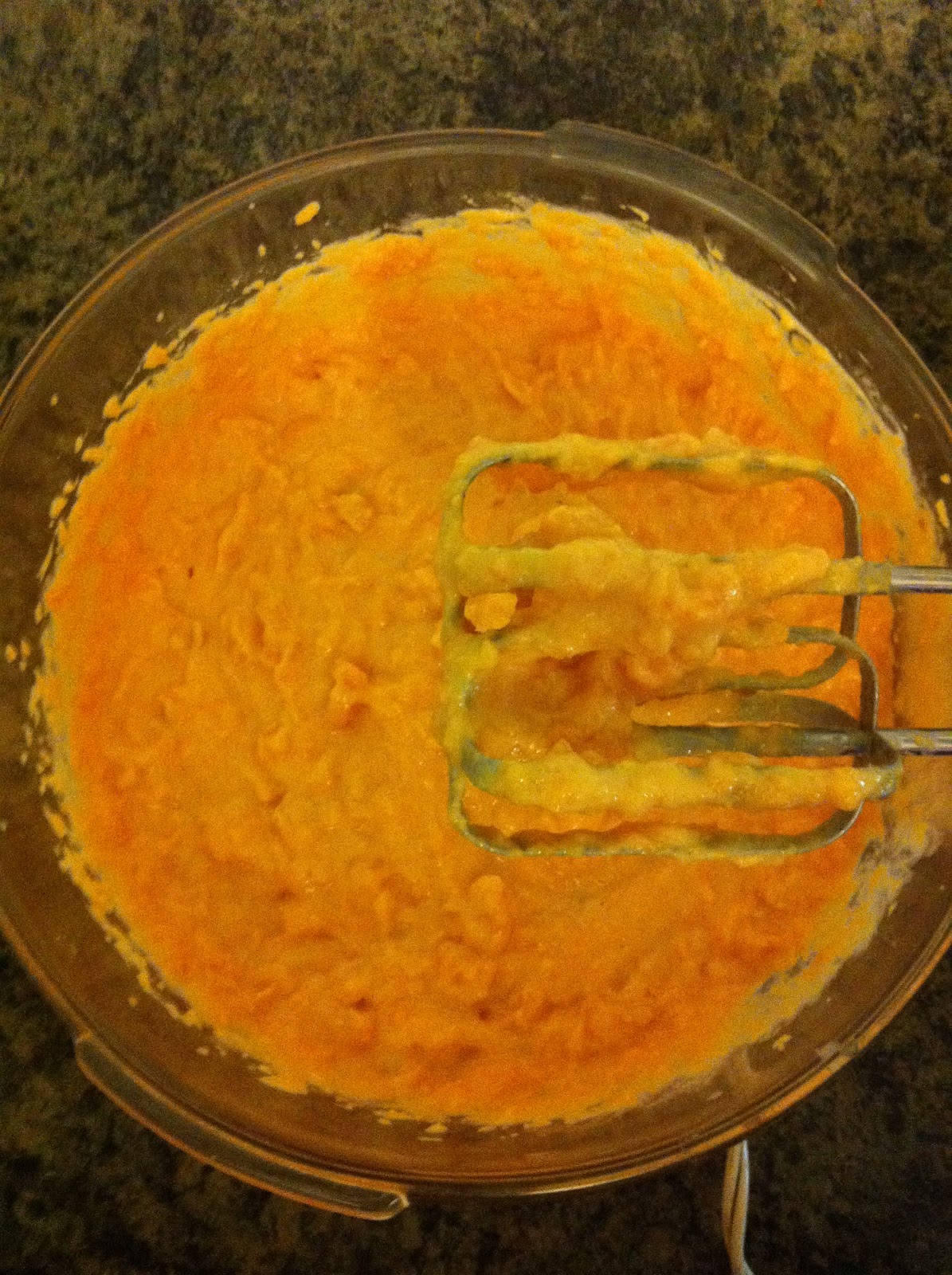
Blend together the cooked sweet potatoes and yogurt at high speed until well-incorporated.
Spoon the batter into ice cube trays and freeze.

Makes about 3 trays of (42 individual) dog treats that are also suitable for human consumption (and surprisingly delicious, even with no added salt or sugar, as I can report from personal experience). I usually ask my dogs eat them outside on the cement patio because of the mess. If you decide to let your dogs eat these in the kitchen, be assured that they will lick the floor clean!

26 June 2011

Lapin à la Moutarde (Rabbit in Mustard Cream Sauce)

Rabbit hind quarter in mustard sauce.
For a short time during the mid-'70s, when I was attending Northern Illinois University, I was unattached and loving it. I would take myself on extended day trips into Chicago for museum crawls, ethnic festivals, often followed by a light dinner at The Berghoff (cheap eats in the late 1970's: escargot, a basket of bread, a glass of white wine, and a generous tip for the cute waiter in the bow tie = $5). I spoiled myself regularly. 

I had a fantasy (which eventually came true) that I would fall in love with a man as interested in art and music and film and literature and travel and international cuisine as I was. In pursuit of that dream, I would, from time to time, invite someone with potential to join me in the windy city. 

The following recipe is a recreation of a dish that I had at a French bistro-style restaurant in Chicago in 1977. I don't remember the name of the restaurant or the name of my date that night, but I do remember that it was a very long and interesting day. We'd started at the Field Museum, spent considerable time wandering through the Art Institute, and ended up at a foreign film festival. We saw three movies, including the 1960's French film Shoot the Piano Player, which I enjoyed immensely for its absurdities, its stylized violence, and its send-up of Hollywood mobster films. For a few hours, I thought I'd found my kindred spirit.

Thirty seconds after the waiter handed us our menus, however, my date's mask slid off. "This menu is in a foreign language!" he snarled. "Oh, for God's sake! Look at these prices!"

I stared back at him, dumb-founded. "Don't worry about the prices. My treat."

"But how can I order when I can't even read the menu!" he said.

Clearly, he one was not The One. I steered him toward the bifsteak (steak) and pommes frites (fried potatoes).

I order rabbit, for the first time . . . and fell in love!


Ingredients
  • 1 rabbit (2 to 2 1⁄2 lbs.), cut into 6 to 8 pieces
  • salt and black pepper
  • 3 slices of good quality bacon, cut into small pieces
  • 1 medium onion, diced
  • 2 cloves of garlic, crushed
  • 1 bay leaf
  • 1 tsp. dried thyme leaves
  • 1 tablespoon whole mustard seeds
  • 2 cups chicken broth
  • 1 cup crème fraîche
  • 1/2 cup dijon mustard
Get Cooking!

1.  Salt and pepper the rabbit pieces.
2.  Starting with a cold pan, fry the bacon pieces over low heat, rendering out the fat.
3.  Turn the heat to medium and brown the rabbit pieces in the bacon fat.
     
    4.  Toss in the diced onion and crushed garlic, the bay leaf, thyme and mustard seeds. Move the rabbit pieces around in the pan so that the onion is at the bottom. Continue to cook until the onion is translucent.
    5.  Deglaze with chicken stock and bring the pot back up to a boil. Lower the heat to low, put a lid on the pan and slow simmer for 1 to 1 1/4 hours. 
    6.  Remove the lid, increase the heat, and boil until the liquid in the pan is reduced by half.
    7. Add the crème fraîche and dijon mustard and stir. Heat through.
    8. Oooo-la-la!! Serve over boiled potatoes or pasta.
    Oops! I forgot to take a picture of the whole plate. Here's the remnants of the rabbit, extra sauce on my remaining garlic smashed potatoes, and steamed green beans and mushrooms on the side.
     Serves 4 and freezes well.

19 June 2011

Malaysian-style Beef Rendang Made for No Particular Reason Except That I Wanted Some

I made my favorite food on the planet--beef rendang--a few weeks ago. It's been four or more years since I last made it. It's very rich, so I usually reserve it for special occasions, like someone else's birthday or a New Year's Eve party with friends. Lately, however, I've come to the realization that waiting for rendang is probably not a wise use of the time I have remaining on Earth. Life is short. Time is running out. Seize the day! Make the rendang! 

There are a million different recipes for rendang, the celebrated Southeast Asian feast food made from meat braised in coconut milk and spices. It amazes me how varied the recipes are and how different the final dish can look--from soupy/sauce-y and bright red to bone dry (a kind of dish known as a "dry curry") and nearly black. Some cooks don't use lemongrass at all; others omit the ground spices and just heap on the lemongrass and kaffir lime leaves. Some use a fiery blend of raw and dried chillies; others offer only the tiniest background prick of capsicum heat.

Chicken appears in a number of the online recipes, though I have never tasted chicken rendang and can't imagine chicken meat standing up to the long cooking time. (Maybe a stewing hen would work, but they aren't readily available at most American groceries.) I have tasted lamb rendang and enjoyed it, but for me, rendang means beef or water buffalo . . . or cow.
Rendang served with plain basmati rice, cucumbers and tomatoes.
The "beef" used in this particular demonstration of rendang is cow. After hearing about and reading too many real life horror stories about the U.S. corn industry, feed lots, and how cattle are made mortally ill by what we make them eat, I have given up consuming commercially-produced beef. This is not easy; I love beef.

I have no problem with, no guilt about, the fact that animals have to die for me to be a dedicated omnivore. I do have trouble, however, with the idea that the animal I'm eating was abused and tortured before ending up on my plate. Cruelty is not palatable. Nor is it necessary. As Temple Grandin says, "Nature is cruel, but we don't have to be."

For this day's recipe, I managed to acquire the meat of a retired, grass-fed, free-range dairy cow who was treated well all her life. In celebration of her life and ours, I offer the following:

Happy Cow Rendang

I can't speak to the authenticity of my recipe, since I developed it over a number of years in an information vacuum (this was back in the '80s, before Internet food blogs from around the world) and without easy access to key ingredients. When I lived in eastern Washington, in fact, I had to have one of my sisters ship coconut milk, lemongrass and kaffir lime leaves from her home in San Francisco.  My mom would also send me ingredients, when she could find them for herself, from her home near Chicago. My willingness to hassle family members for ingredients, and sacrifice to raise the money for the shipping costs when I was dirt poor, is testimony to my love of this dish.

As I was developing this recipe, all I had to go on was a series of memories--memories of eating rendang at weddings and at neighbors' and friends' homes during Hari Raya Puasa (the end of the Muslim fasting month of Ramadan) and memories of standing over a steaming kuali (a.k.a. 'wok'), stirring and stirring a rich meat and coconut milk stew under the guidance of our cook in Kampung Baru when I was all of six or seven. 
Dried red chillis (these are Chile de Arbol) in hot water. I was halfway through snipping these chillis into small pieces with my kitchen shears before I remembered to take a picture, which is why some of the chillis are whole and some are not.)
  • 3 lbs. stewing beef, cubed
  • 3 tablespoons peanut or canola oil (or coconut oil, if you can find it)
  • large yellow onion, diced
  • 2-inches ginger root, peeled and minced
  • 8 or so garlic cloves, crushed
  • 4 stalks of lemongrass, cut into short segments (if not available in your product section, these are available from online Asian groceries)
  • 6-8 kaffir lime leaves (if not available in your product section, these are available from online Asian groceries)
  • 2-3 star anise
  • 2 sticks cinnamon
  • 3 tablespoons ground coriander
  • 2 tablespoons ground cumin
  • 1/2 teaspoon ground clove
  • 1/2 teaspoon ground nutmeg
  • 6 dried red chillies (Chile de Arbol, dried Cayenne and Thai chillies are easiest to find in the American midwest), seeds removed, reconstituted in 1/2 cup of boiling water; cut into small pieces. [This made a medium-spicy rendang. Add more if you prefer more heat.]
  • 2+ cans unsweetened coconut milk
  • 1 cup dessicated coconut, toasted (For me, dessicated coconut has always been the hardest ingredient to find. Do not use the sweet shredded coconut that we use in the U.S. for cookies, cakes and other desserts. What you want here is unsweetened, dried coconut meat with no additives. My supplier is the bulk foods aisle at Whole Foods in Cleveland, about an hour's drive away.)
  • salt to taste (DO NOT ADD until after coconut milk has boiled down)

1.  In a heavy dutch oven, brown the beef in oil in small batches. Do not crowd the pan, or the meat will steam rather than brown. Set the browned meat aside.

2.  Into the hot pan, toss the diced onion, ginger root and garlic. Stir fry until the onion pieces are translucent and soft, about 10 minutes.

3. Add the lemongrass, kaffir lime leaves, star anise, cinnamon sticks, and ground spices. Stir fry another few minutes, until the spices start to release their fragrance.

4. Add the coconut milk and deglaze the pan (that is, scrape all those bits of meat and onion from the bottom of the pan). Add the meat back into the pan, along with the chilli pieces and their water.

5. Bring this beige-ugly stew to a boil, then turn the heat down to very, very low. Cover the pan with a heavy lid and allow to slow stew for at least 2 or 3 hours. You can add more coconut milk, if you need to. As time goes on, an astounding, heavenly aroma will begin to fill your house. [Note: The more authentic way to cook rendang is in an open wok over a low flame, adding more coconut milk as it boils away. However, because coconut milk is expensive and sometimes hard to find in Ohio, I prefer to put a lid on the pot to slow down the evaporation of the coconut milk, at least until the meat is very tender. An added advantage to the closed-pot method is that, in the end, there are fewer calories in the final dish because there is less coconut oil.]
6.  Toast the dessicated coconut in a dry pan until deep brown. Be careful. The coconut will not seem to be toasting for quite a while; then, suddenly, it will go golden and brown fast. I usually turn off the heat when the  coconut is golden and allow the residual heat of the pan to finish the toasting.
7. When the beef is very, very tender (or even falling apart), it's time to reduce the braising sauce  to a paste. Turn up the heat and keep stirring as the liquid boils away. Stir and stir and stir. It is vitally important to keep stirring, as the thickening concoction will tend to scorch and burn. When most of the liquid is gone, you can add some salt, to taste.

8. As you stir, remove those hard-to-chew aromatics--the lemongrass, lime leaves, cinnamon sticks and star anise pieces. These you can throw away or compost.

9. When the sauce is very, very thick, add the toasted coconut and keep stirring. Eventually, the rendang sauce will start to pull away from the pan and stick to the meat. This means it's done! Turn off the heat.

Makes 12 to 16 servings. Traditionally served over steamed rice or with roti, Malay flat bread. Fortunately, rendang freezes well, so I will be setting aside a good portion for Ground Hog Day (my birthday).

Below is a one-handed video of steps 6, 7 and 8 combined. (My first cooking video! My apologies for mumbling. I spoke as if I was talking to myself instead of to you, my audience. I'll try to do better next time.)

18 June 2011

See-Through Food, Part 2: Easy Rice Paper Wraps

You can put just about anything (that is not wet or soggy) in a rice paper wrap. My favorite things to wrap are salad ingredients, blanched or roasted vegetables, fresh herbs and pieces of cooked seafood or chicken. I've had rice paper wraps in Seattle that contained glass noodles and ones that contained rice noodles. Both were wonderful, but because I tend to use these as a salad substitute, I have never made them with a noodle filling.

For today's wraps, I used baby lettuce greens, finely shredded cabbage, basil leaves, blanched snow peas, and poached and chilled 16-20 count shrimp.

Rice paper is made from rice starch, tapioca starch, water and salt. They come in several sizes, but I prefer the big ones that are 8 1/2 inches across and easier to handle than the smaller ones.


The sheets are very thin and brittle, so when you are buying them, check the package carefully so that you do not end up with a package of shattered sheets, which are almost impossible to work with.

To make the sheets pliable enough to bend and manipulate, you will need to dip them in water. The following directions for using rice paper are a little different than the other directions I've seen, including the ones on the rice paper package. I'll explain as I go along.
 
Half fill a pie plate or quiche pan (large enough hold a rice paper sheet) with room-temperature water. (I do not use hot water because I find that the sheets become too soggy too quickly.)

Place a sheet of rice paper in the water and push it down to the bottom of the plate or pan, then lift it out immediately. (I do not leave the rice paper in the water for any real time because, once again, it will become too water-logged and tear more easily while I'm working with it.)

Lay the water-dipped sheet on a clean, dry work surface, like a cutting board or counter top. (I don't use a dish cloth, as some people suggest, because one time I ended up with bits of cotton lint stuck to the outsides of my wraps...ugh!) A wooden work surface, I find, works best.


Keeping in mind that this is a see-through food, start layering your ingredients across the near edge of the rice paper sheet, leaving room at the sides so that you can later fold the ends in. I put the shrimp (split in half the long way with their pink side out) on the bottom of the pile or on the top, so that they will be easily seen once the wrap is done.

When you first start working, the sheet will still be a bit stiff, but don't worry about it. Within a minute or two--about the time it takes for you to layer on your wrap's filling ingredients--the sheet will become very pliable and a bit stretchy.


Wrap the rice paper around your ingredients as you would a burrito or egg roll. Wrap as tightly as you can without tearing the paper.

Wipe the moisture off your work surface before starting to construct your next wrap.

I like a very light Thai-style dipping sauce for these, although I have also enjoyed them with a simple vinaigrette. These wraps were served (to me by me) with a dipping sauce made of equal parts lime juice, fish sauce and water, with a splash of Thai Sriracha hot sauce. Yum!

See-Through Food, Part 1: Glass Noodle Soup


Glass noodles (a.k.a. "cellophane noodles" or "bean thread noodles") are made from water and mung beans. (Sprouted mung beans are what we call bean sprouts, commonly used in Chinese stir-fries.)
Dried cellophane noodles and dried mung beans.

This take on Vietnamese glass noodle soup is another easy meal for one or two. It requires a bit of prep (cutting up veggies and soaking noodles) but, all-in-all, it's not very time consuming or difficult to make.
Start by choosing two or three vegetable for your soup. Keep it light and uncomplicated, in keeping with the Asian theme. Today I chose two veggies for my soup: fresh shitake mushrooms and broccolini. You'll also need a few other ingredients for this soup. Here's the entire list:
  • 1.5 oz. glass noodles (also called bean thread noodles, cellophane noodles, or mung bean noodles), reconstituted in boiling water, then drained
  • 2 cups water
  • 1 teaspoon bouillon paste or cube (chicken or veggie work best)
  • 1 large clove garlic, thinly sliced
  • 1 piece of ginger root (about the same size as the garlic clove)
  • 1 dried chilli (optional)
  • handful of fresh mushrooms, sliced
  • handful or two fresh vegetables (snow peas are good, as is savoy cabbage, broccoli, bean sprouts, or whatever you like), cut into bite-size pieces
  • 2 to 4 oz. shrimp or fish or shredded cooked chicken or tofu can also be added, though I tend to prefer a meatless (except of the broth) glass noodle soup 
  • juice of 1 lime
  • 1 tablespoon Vietnamese or Thai fish sauce
Prep

Put the dry noodle in a bowl and cover with boiling water. Let them set for 10 minutes or until the water cools down significantly and the noodles are clear. Drain the water off the noodles and set the noodles aside.
Cover noodles with hot water.

After 5 minutes, noodles are pliable but not clear.

Clear glass noodles.

Noodles are ready to drain and use.
Reconstituted and drained glass noodles at the bottom of my soup bowl awaiting the rest of the soup.
While the noodles are reconstituting, prep your veggies.

Thinly slice the garlic and cut the ginger root into tiny little shreds. Clean your vegetables and cut them into bite-size pieces.

Get Cooking:
Heat 2 cups of water in a medium soup pan. When it comes to a boil, add the bouillon base, garlic and ginger pieces, and whole chilli (if using). Simmer for 2 minutes or so, then start adding the vegetables (and seafood or meat, if using). Continue to simmer for another 3 to 5 minutes, until the vegetables are crisp-tender or cooked to your liking.

Turn off the heat and add the fish sauce and lime juice.  Remove and discard the chilli pepper (unless you need to use it in a food porn photograph like the one below). Pour the soup over the glass noodles, stir, and enjoy.